Neuro-Physiotherapist
Neuromuscular re-education, joint mobility, balance, and gait practice tailored to assessment.
Rebuild mobility, practice daily skills, and work toward greater independence with therapist-led rehabilitation coordinated with your clinical team.
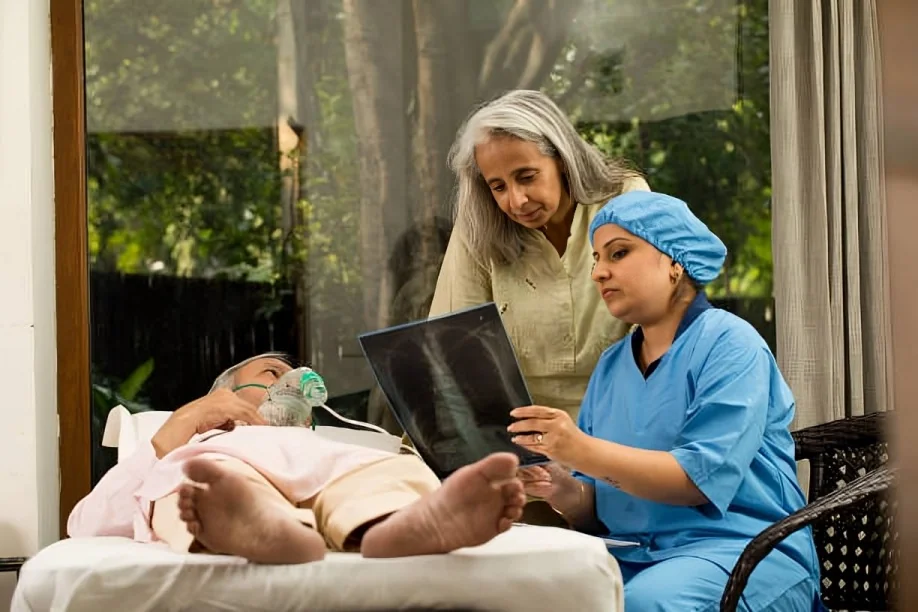
Recovery after a stroke, brain injury, spinal cord trauma, or joint replacement may involve structured physical and functional rehabilitation. Ashok Healthcare, founded by Ashok Doddamani (B.Sc Nursing, MBA), coordinates home-based neuro and orthopedic rehabilitation with experienced clinical teams. Our mobile care teams serve Yeshwanthpur, Malleshwaram, Rajajinagar, Hebbal, Peenya, Mathikere, Jalahalli, Basaveshwar Nagar, Mahalakshmi Layout, Sadashivanagar, and other Bengaluru areas. Care and timing depend on assessment and treating-clinician guidance.
| Service Focus | Possible indications and interventions |
|---|---|
| Neuro rehabilitation at home |
|
| Orthopedic rehabilitation at home |
|
The appropriate therapy, frequency, and goals depend on the patient's condition, assessment, precautions, and treating clinician's advice. Rehabilitation outcomes and timelines vary between individuals.
The treating therapist may track mobility, joint range with a goniometer, balance, strength, and daily function using appropriate measures such as the Barthel Index. The example goals below are planning references only—not promised milestones, timelines, or outcomes. A therapist sets appropriate targets after assessment and in coordination with the treating physician.
| Review period | Examples of neuro-rehabilitation goals | Examples of orthopedic goals |
|---|---|---|
| Weeks 1–2 · acute recovery | Possible goals include passive range-of-motion practice, trunk stability, supported bed-sitting balance, and early movement in affected limbs. | Possible goals include knee flexion in a clinician-set range (sometimes 60°–90°), safe bed-to-walker transfers, and incision/swelling monitoring. |
| Weeks 3–4 · sub-acute phase | Possible goals include active-assisted standing balance, upper-limb reach/grasp practice, and tracking functional change with an appropriate measure. | Possible goals include progression of knee flexion (sometimes toward 90°–110°) and safe walking practice with the prescribed aid. |
| Weeks 5–8 · functional phase | Possible goals include gait, hand-eye coordination, and daily activity practice according to individual progress. | Possible goals may include further knee range, stairs, and outdoor mobility when cleared by the treating team. |
Complex recovery may require more than physiotherapy. Depending on the patient's needs and local availability, the care team can discuss coordination with:
Neuromuscular re-education, joint mobility, balance, and gait practice tailored to assessment.
Support or referral for aphasia, communication, and dysphagia/swallowing needs where available.
Practice daily activities such as feeding, grooming, dressing, buttoning, and writing.
Nursing, tube-feeding, catheter, and wound-care needs, plus dietitian coordination, as prescribed and available.
Ashok Surgical may coordinate delivery and setup of rehabilitation equipment across North Bengaluru, subject to stock, location, and clinical suitability. Timing is confirmed at booking. Use equipment only after instructions from the treating clinician or therapist.
May be considered for selected post-operative knee rehabilitation when prescribed or approved by the treating surgeon.
Electrical stimulation equipment may be used only when clinically indicated and guided by a qualified professional.
Possible supports for supervised balance and weight-bearing practice, subject to home space and clinical assessment.
Transfer and upright-positioning aids may be considered after assessment and appropriate safety planning.
The following windows are estimates only, not guaranteed arrival times. Actual dispatch depends on location, traffic, clinical assessment, and therapist or equipment availability.
| Area | Indicative response estimate |
|---|---|
| Yeshwanthpur & Mathikere | Approximately 1–2 hours when available |
| Malleshwaram & Rajajinagar | Approximately 2–3 hours when available |
| Peenya, Jalahalli & Goraguntepalya | Approximately 2–3 hours when available |
| Hebbal, Sadashivanagar & Mahalakshmi Layout | Approximately 2–3 hours when available |
| Yelahanka, Vidyaranyapura & Greater Bangalore | Approximately 3–4 hours when available |
Review hospital notes, surgical precautions, and mobility restrictions shared by the family.
Coordinate rehabilitation around treating-clinician guidance and patient consent.
Record relevant mobility, range-of-motion, balance, and functional observations where appropriate.
Progress information may be shared with the treating physician with the patient's consent.
Explore related care and equipment options:
Rehabilitation should begin only after the treating doctor has medically cleared the patient. Timing varies with the patient's condition and discharge instructions; the team can review those instructions and discuss an assessment, often soon after discharge if clinically appropriate.
General physiotherapy often addresses musculoskeletal pain, injury, mobility, or post-operative needs. Neuro physiotherapy focuses on movement, balance, coordination, and function affected by neurological conditions, tailored to individual assessment.
A CPM machine may be available through Ashok Surgical, subject to stock and clinical suitability. Confirm availability and rental terms; use the machine only according to the treating surgeon or physiotherapist's instructions.
Contact the Yeshwanthpur hub to discuss scheduling and a suitable replacement if available. Replacement timing depends on the patient's needs, location, and therapist availability.
Portable equipment depends on the therapist's assessment and the patient's plan. Larger equipment such as CPM machines or parallel bars may be arranged separately through Ashok Surgical, subject to availability.
Speak with the care team to discuss rehabilitation requirements, therapist availability, and equipment options.
Address: #28, Ground Floor, 4th Cross Rd, A.T. Street, Dr. Ambedkar Nagar, Yeshwanthpur, Bengaluru, Karnataka 560022
Helpline: +91 78297 53538
Email: info@ashokhealthcare.in